Hydrogen Fuel Cell
www.HydrogenFuelCell.net

Hydrogen Fuel Cell and Onsite Power Generation
Including our
Cogeneration and Trigeneration Energy Systems

Cogeneration, Demand Side Management, Micro-Grid Solutions
Solar Energy Systems, and Trigeneration Energy Systems that 
Reduce or Eliminate Energy Expenses &
Greenhouse Gas Emissions  
for Commercial & Industrial Clients

Our Trigeneration Energy Systems 
Generate Three Forms of Energy: 
Cooling, Heating & Power
For the Price of One
!


We Sell and Install
Cogeneration and Trigeneration  
Energy Systems That Exceed 85% Efficiency


We Sell and Install
Solar Trigeneration
Energy Systems that can make your facility a
Net Zero Energy Building


One of our customers (office building in Los Angeles) with our 
Solar Trigeneration™ system has been "dis-connected" from the 
electric grid for over 6 years and has never been affected by 
any of the black-outs or rolling black-outs during this time.


Our
Cogeneration and Trigeneration Power Plants are about 
300% More Efficient than "Central" Power Plants


Engineering, Feasibility Studies & Consulting Services
Provided by In-house Engineers and Consultants or 
Through the Renewable Energy Institute


Equity
positions now available for qualified joint venture partner(s) in our new ESCO
with over one hundred new
Demand Side Management customers who have agreed to have our Onsite Power Generation system installed at their business under our 20 year Energy Services Agreement. Our packaged cogeneration and trigeneration energy systems will be installed at our customer's locations, providing them with clean power and energy and at prices that save them thousands of dollars.

Our new company is an ESCO (Energy Service Company) and provides our qualified commercial clients with energy solutions that we provide them, with little to no upfront costs. Under the agreement, we design, install and own/operate/maintain the energy solutions for our clients and share in the energy savings our solutions provide at our customer's business.

Our present, prospective customers that have been introduced to us by a strategic partner, include over one hundred commercial clients, and include:

Casinos
Colleges
Convenience Stores
Data Centers
Department Stores
Fast-food Restaurants
Health Clubs
Hospitals
Hotels
Laundries
Radio and Television Stations
Restaurants
Schools
Universities

For qualified commercial customers, we will install our demand side management solution, including our cogeneration, trigeneration or solar trigeneration energy system at your business, with little to no up-front cost.  We then become your private power company - generating clean power and energy and share in the energy savings our systems provide. 

Whether your business owns the energy system through a purchase, or we own - operate - and maintain through and Energy Services Agreement and sell the power and energy to your business at a discount - your business will have lower your power and energy
expenses while significantly reducing your
greenhouse gas emissions.

For inquiries about one of our Demand Side Management solutions, including our cogeneration, trigeneration, solar trigeneration or help in making your facility a Net Zero Energy Building™  and learn if your business may qualify for the installation of our solutions at little to no up-front cost, call or email us:


Tel.  (
88321) 758 -10027


Email:  info@Trigeneration.com


Now accepting resumes (by email only) from sales professionals with a successful background in selling; Demand Side Management solutions, onsite power (including solar), peak-shaving and Onsite Power Generation systems to Fortune 1000 companies.


Email:  info@HydrogenFuelCell.net

Tel.   (08327)27584- 00279  


Hydrogen Fuel Cell
www.HydrogenFuelCell.net

We provide renewable energy project development solutions; design, engineering, feasibility studies and consulting services that include Onsite Cogeneration and Trigeneration power plants that are powered by Hydrogen Fuel Cells.


Hydrogen Fuel Cells

Hydrogen's potential use in fuel and energy applications includes powering vehicles, running turbines or fuel cells to produce electricity, and generating heat and electricity for buildings. The current focus is on hydrogen's use in fuel cells. 


A fuel cell works like a battery but does not run down or need recharging. It will produce electricity and heat as long as fuel (hydrogen) is supplied. A fuel cell consists of two electrodes—a negative electrode (or anode) and a positive electrode (or cathode)—sandwiched around an electrolyte. Hydrogen is fed to the anode, and oxygen is fed to the cathode. Activated by a catalyst, hydrogen atoms separate into protons and electrons, which take different paths to the cathode. The electrons go through an external circuit, creating a flow of electricity. The protons migrate through the electrolyte to the cathode, where they reunite with oxygen and the electrons to produce water and heat. Fuel cells can be used to power vehicles or to provide electricity and heat to buildings. 

The primary fuel cell technologies under development are: 

Phosphoric Acid Fuel Cells

A phosphoric acid fuel cell (PAFC) consists of an anode and a cathode made of a finely dispersed platinum catalyst on carbon paper, and a silicon carbide matrix that holds the phosphoric acid electrolyte. This is the most commercially developed type of fuel cell and is being used in hotels, hospitals, and office buildings. The phosphoric acid fuel cell can also be used in large vehicles, such as buses. 

Proton-Exchange Membrane Fuel Cells

The proton-exchange membrane (PEM) fuel cell uses a fluorocarbon ion exchange with a polymeric membrane as the electrolyte. The PEM cell appears to be more adaptable to automobile use than the PAFC type of cell. These cells operate at relatively low temperatures and can vary their output to meet shifting power demands. These cells are the best candidates for light-duty vehicles, for buildings, and much smaller applications. 

Solid Oxide Fuel Cells

Solid oxide fuel cells (SOFC) currently under development use a thin layer of zirconium oxide as a solid ceramic electrolyte, and include a lanthanum manganate cathode and a nickel-zirconia anode. This is a promising option for high-powered applications, such as industrial uses or central electricity generating stations. 

Direct-Methanol Fuel Cells

A relatively new member of the fuel-cell family, the direct-methanol fuel cell (DMFC) is similar to the PEM cell in that it uses a polymer membrane as an electrolyte. However, a catalyst on the DMFC anode draws hydrogen from liquid methanol, eliminating the need for a fuel reformer. 

Molten Carbonate Fuel Cells

The molten carbonate fuel cell uses a molten carbonate salt as the electrolyte. It has the potential to be fueled with coal-derived fuel gases or natural gas. 

Alkaline Fuel Cells


The alkaline fuel cell uses an alkaline electrolyte such as potassium hydroxide. Originally used by NASA on space missions, it is now finding applications in hydrogen-powered vehicles. 

Regenerative Fuel Cells

This special class of fuel cells produces electricity from hydrogen and oxygen, but can be reversed and powered with electricity to produce hydrogen and oxygen. Hydrogen Fuel
Since the early 19th century, scientists have recognized hydrogen as a potential source of fuel. Current uses of hydrogen are in industrial processes, rocket fuel, and spacecraft propulsion. With further research and development, this fuel could also serve as an alternative source of energy for heating and lighting homes, generating electricity, and fueling motor vehicles. When produced from renewable resources and technologies, such as hydro, solar, and wind energy, hydrogen becomes a renewable fuel. 

Composition of Hydrogen

Hydrogen is the simplest and most common element in the universe. It has the highest energy content per unit of weight—52,000 British Thermal Units (Btu) per pound (or 120.7 kilojoules per gram)—of any known fuel. Moreover, when cooled to a liquid state, this low-weight fuel takes up 1/700 as much space as it does in its gaseous state. This is one reason hydrogen is used as a fuel for rocket and spacecraft propulsion, which requires fuel that is low-weight, compact, and has a high energy content. 

In a free state and under normal conditions, hydrogen is a colorless, odorless, and tasteless gas. The basic hydrogen (H) molecule exists as two atoms bound together by shared electrons. Each atom is composed of one proton and one orbiting electron. Since hydrogen is about 1/14 as dense as air, some scientists believe it to be the source of all other elements through the process of nuclear fusion. It usually exists in combination with other elements, such as oxygen in water, carbon in methane, and in trace elements as organic compounds. Because it is so chemically active, it rarely stands alone as an element. 

When burned (or combined) with pure oxygen, the only by products are heat and water. When burned (or combined) with air, which is about 68% nitrogen, some oxides of nitrogen (Nitrogen Oxides or NOx) are formed. Even then, burning hydrogen produces less air pollutants relative to fossil fuels. 

Producing HydrogenHydrogen bound in organic matter and in water makes up 70% of the earth's surface. Breaking up these bonds in water allows us produce hydrogen and then to use it as a fuel. There are numerous processes that can be used to break these bonds. Described below are a few methods for producing hydrogen that are currently used, or are under research and development. 

Most of the hydrogen now produced in the United States is on an industrial scale by the process of steam reforming, or as a byproduct of petroleum refining and chemicals production. Steam reforming uses thermal energy to separate hydrogen from the carbon components in methane and methanol, and involves the reaction of these fuels with steam on catalytic surfaces. The first step of the reaction decomposes the fuel into hydrogen and carbon monoxide. Then a "shift reaction" changes the carbon monoxide and water to carbon dioxide and hydrogen. These reactions occur at temperatures of 392° F (200 ° C) or greater. 

Another way to produce hydrogen is by electrolysis. Electrolysis separates the elements of water—H and oxygen (O)—by charging water with an electrical current. Adding an electrolyte such as salt improves the conductivity of the water and increases the efficiency of the process. The charge breaks the chemical bond between the hydrogen and oxygen and splits apart the atomic components, creating charged particles called ions. The ions form at two poles: the anode, which is positively charged, and the cathode, which is negatively charged. Hydrogen gathers at the cathode and the anode attracts oxygen. A voltage of 1.24 Volts is necessary to separate hydrogen from oxygen in pure water at 77° Fahrenheit (F) and 14.7 pounds per square inch pressure [25° Celsius (C) and 1.03 kilograms (kg) per centimeter squared.] This voltage requirement increases or decreases with changes in temperature and pressure. 

The smallest amount of electricity necessary to electrolyze one mole of water is 65.3 Watt-hours (at 77° F; 25 degrees C). Producing one cubit foot of hydrogen requires 0.14 kilowatt-hours (kWh) of electricity (or 4.8 kWh per cubic meter). 

Renewable energy sources can produce electricity for electrolysis. For example, Humboldt State University's Schatz Energy Research Center designed and built a stand-alone solar hydrogen system. The system uses a 9.2 kilowatt (KW) photovoltaic (PV) array to provide power to compressors that aerate fish tanks. The power not used to run the compressors runs a 7.2 kilowatt bipolar alkaline electrolyzer. The electrolyzer can produce 53 standard cubic feet of hydrogen per hour (25 liters per minute). The unit has been operating without supervision since 1993. When there is not enough power from the PV array, the hydrogen provides fuel for a 1.5 kilowatt proton exchange membrane fuel cell to provide power for the compressors. 

Steam electrolysis is a variation of the conventional electrolysis process. Some of the energy needed to split the water is added as heat instead of electricity, making the process more efficient than conventional electrolysis. At 2,500 degrees Celsius water decomposes into hydrogen and oxygen. This heat could be provided by a concentrating solar energy device. The problem here is to prevent the hydrogen and oxygen from recombining at the high temperatures used in the process. 

Thermochemical water splitting uses chemicals such as bromine or iodine, assisted by heat. This causes the water molecule to split. It takes several steps—usually three—to accomplish this entire process. 

Photoelectrochemical processes use two types of electrochemical systems to produce hydrogen. One uses soluble metal complexes as a catalyst, while the other uses semiconductor surfaces. When the soluble metal complex dissolves, the complex absorbs solar energy and produces an electrical charge that drives the water splitting reaction. This process mimics photosynthesis. 

The other method uses semiconducting electrodes in a photochemical cell to convert optical energy into chemical energy. The semiconductor surface serves two functions, to absorb solar energy and to act as an electrode. Light-induced corrosion limits the useful life of the semiconductor. 

Researchers at the University of Tennessee and U.S. Department of Energy's (DOE) Oak Ridge National Laboratory are researching ways to use photosynthesis to produce hydrogen from sunlight. The researchers extracted two photosynthetic complexes from spinach plants; called Photosystem I and Photosystem II. The two work together to produce carbohydrates for the plant. By attaching platinum atoms to the Photosystem I complexes, the researchers were able to produce hydrogen from visible light. Unfortunately, the process required the use of an added chemical that makes the overall process impractical, but the achievement shows potential. The researchers are working to combine the platinum-Photosystem I complexes with the Photosystem II complexes, forming a molecular system that can convert light and water directly into hydrogen, without help from an added chemical. 

Biological and photobiological processes can use algae and bacteria to produce hydrogen. Under specific conditions, the pigments in certain types of algae absorb solar energy. The enzyme in the cell acts as a catalyst to split the water molecules. Some bacteria are also capable of producing hydrogen, but unlike algae they require a substrate to grow on. The organisms not only produce hydrogen, but can clean up pollution as well. 

Research funded by DOE has led to the discovery of a mechanism to produce significant quantities of hydrogen from algae. Scientists have known for decades that algae produce trace amounts of hydrogen, but had not found a feasible method to increase the production of hydrogen. Scientists from the University of California (UC), Berkeley, and the U.S. DOE's National Renewable Energy Laboratory found the key. After allowing the algae culture to grow under normal conditions, the research team deprived it of both sulfur and oxygen, causing it to switch to an alternate metabolism that generates hydrogen. After several days of generating hydrogen, the algae culture was returned to normal conditions for a few days, allowing it to store up more energy. The process could be repeated many times. Producing hydrogen from algae could eventually provide a cost-effective and practical means to convert sunlight into hydrogen. 

Another source of hydrogen produced through natural processes is methane and ethanol. Methane (CH4) is a component of "biogas" that is produced by anaerobic bacteria. Anaerobic bacteria occur widely throughout the environment. They break down or "digest" organic material in the absence of oxygen and produce biogas as a waste product. Sources of biogas include landfills, and livestock waste and municipal sewage treatment facilities. Methane is also the principal component of "natural gas" (a major heating and power plant fuel) produced by anaerobic bacteria eons ago. Ethanol is produced by the fermentation of biomass. Most fuel ethanol produced in the United States is made from corn. 

Chemical engineers at the University of Wisconsin-Madison have developed a process to produce hydrogen from glucose, a sugar produced by many plants. The process shows particular promise because it occurs at relatively low temperatures, and can produce fuel-cell-grade hydrogen in a single step. Glucose is manufactured in vast quantities from corn starch, but can also be derived from sugar beets or low-cost waste streams like paper mill sludge, cheese whey, corn stover or wood waste. 

The United States, Japan, Canada, and France have investigated thermal water splitting, a radically different approach to creating hydrogen. This process uses heat of up to 5,430°F (3,000°C) to split water molecules. 

Potential Uses for Hydrogen

When properly stored, hydrogen as a fuel burns in either a gaseous or liquid state. Motor vehicles and furnaces can be converted to use hydrogen as a fuel. Hydrogen has actually been used in the transportation, industrial, and residential sectors in the United States for many years. Many people in the late 19th century burned a fuel called "town gas," which is a mixture of hydrogen and carbon monoxide. Several countries, including Brazil and Germany, still distribute this fuel. Hydrogen was used in early "hot-air" balloons, and later in airships (dirigibles) during the early 1900's. Gaseous hydrogen was used in 1820 as fuel for one of the earliest internal combustion engines. The U.S. Air Force had a secret, multi-million dollar program during the 1950's, code-named "Suntan," to develop hydrogen as a fuel for airplanes. Currently, industries use large quantities of hydrogen for refining petroleum, and for producing ammonia and methanol. The Space Shuttle uses hydrogen as fuel for its rockets. Automobile manufacturers have developed hydrogen-powered cars. 

Burning hydrogen creates less air pollution than gasoline or diesel. Hydrogen also has a higher flame speed, wider flammability limits, higher detonation temperature, burns hotter, and takes less energy to ignite than gasoline. This means that hydrogen burns faster, but carries the danger of pre-ignition and flashback. While hydrogen has its advantages as a vehicle fuel it still has a long way to go before it can be used as a substitute for gasoline. This is mainly due to the investment required to develop a hydrogen production and distribution infrastructure. 

However, things are getting started in this regard. Vehicle manufacturers Honda and BMW have set up hydrogen fueling stations as part of their efforts to develop fuel cell powered cars. At Honda's research and development center in Torrance, California, a PV array electrolyses hydrogen from water. The array generates enough hydrogen to power one fuel-cell vehicle. Additional power from the power grid is used to increase the hydrogen production capacity. The new station is supporting Honda's fuel cell vehicle development program for hydrogen production, storage, and fueling. Honda and a fuel cell developer are also working together on a "home" hydrogen refueling system for fuel cell vehicles. BMW opened a hydrogen fueling station at the company's engineering and emissions control test center in Oxnard, California. BMW is taking a different approach than most car companies, burning hydrogen directly in advanced internal-combustion engines, and is testing these vehicles at the Oxnard facility. 

The California Fuel Cell Partnership (CaFCP) is also building a hydrogen infrastructure. The CaFCP commissioned its first "satellite" hydrogen fueling system in late October 2002, in Richmond, California, about 70 miles from the CaFCP headquarters and a primary refueling facility in West Sacramento. This extends the range over which the CaFCP's prototype fuel cell vehicles can be driven. The fueling system uses electrolysis to generate hydrogen from water and includes a storage unit capable of holding 104 pounds (47 kilograms) of hydrogen. It is capable of fueling a small fleet of vehicles and requires only one or two minutes per refueling. 

In November 2002, the world's first hydrogen energy station that can provide fuel for vehicles and also produce electricity opened in Las Vegas Nevada. The station is located in the city's vehicle maintenance and operation service center. It combines an on-site hydrogen generator, compressor, liquid and gaseous hydrogen storage tanks, dispensing systems, and a stationary fuel cell. It is capable of dispensing hydrogen, hydrogen-enriched natural gas, and compressed natural gas. DOE is also working with the city to convert municipal vehicles to operate on hydrogen. 

Fuel cells are a type of technology that use hydrogen to produce useful energy. In fuel cells, electrolysis is reversed by combining hydrogen and oxygen through an electrochemical process, which produces electricity, heat, and water. The U.S. space program has used fuel cells to power spacecraft for decades. Fuel cells capable of powering automobiles and buses have been and are being developed. Several companies are developing fuel cells for stationary power generation. Most major automobile manufacturers are developing fuel cell powered automobiles. 

Hydrogen could be considered a way to store energy produced from renewable resources such as solar, wind, biomass, hydro, and geothermal. For example, when the sun is shining, solar photovoltaic systems can provide the electricity needed to separate the hydrogen (as described above regarding Humboldt State University's Research Center). The hydrogen could then be stored and burned as fuel, or to operate a fuel cell to generate electricity at night or during cloudy periods. 

Storing Hydrogen

In order to use hydrogen on a large scale, safe, practical storage systems must be developed, especially for automobiles. Although hydrogen can be stored as a liquid, it is a difficult process because the hydrogen must be cooled to -423° Fahrenheit (-253° Celsius). Refrigerating hydrogen to this temperature uses the equivalent of 25% to 30% of its energy content, and requires special materials and handling. To cool one pound (0.45 kg) of hydrogen requires 5 kWh of electrical energy. 

Hydrogen may also be stored as a gas, which uses less energy than making liquid hydrogen. As a gas, it must be pressurized to store any appreciable amount. For large-scale use, pressurized Hydrogen gas could be stored in caverns, gas fields, and mines. The hydrogen gas could then be piped into individual homes in the same way as natural gas. Though this means of storage is feasible for heating, it is not practical for transportation because the pressurized metal tanks used for storing hydrogen gas for transportation are very expensive. 

A potentially more efficient method of storing hydrogen is in hydrides. Hydrides are chemical compounds of hydrogen and other materials. Research is currently being conducted on magnesium hydrides. Certain metal alloys such as magnesium nickel, magnesium copper, and iron titanium compounds, absorb hydrogen and release it when heated. Hydrides, however, store little energy per unit weight. Current research aims to produce a compound that will carry a significant amount of hydrogen with a high energy density, release the hydrogen as a fuel, react quickly, and be cost-effective. 

A company in Utah, Power Ball Technologies, has developed a process in which sodium metal is pelletized and encapsulated with polyethylene plastic. The pellets can then be containerized, transported, and then opened in a patented hydrogen generator to produce hydrogen gas. According to the company, each gallon of these pellets is capable of producing 1,307 gallons of hydrogen gas, which is an equivalent hydrogen storage density more than 7 times greater by volume than a compressed hydrogen tank storing hydrogen at 3,000 psi. 

The Cost of Hydrogen


Currently the most cost-effective way to produce hydrogen is steam reforming. According to the U.S. Department of Energy, in 1995 the cost was $7.39 per million Btu ($7.00 per gigajoule) in large plant production. This assumes a cost for natural gas of $2.43 per million Btu ($2.30 per gigajoule). This is the equivalent of $0.93 per gallon ($0.24 per liter) of gasoline. The production of hydrogen by electrolysis using hydroelectricity at off peak rates costs between $10.55 to $21.10 per million Btu ($10.00 to $20.00 per gigajoule). 

Hydrogen Research in the United States

Recognizing the potential for hydrogen fuel, the U.S. Department of Energy (DOE) and private organizations have funded research and development (R&D) programs for several years. DOE has a major effort to develop hydrogen as a major fuel within the next few decades. 


Types of Fuel Cells

Fuel cells are classified primarily by the kind of electrolyte they employ. This determines the kind of chemical reactions that take place in the cell, the kind of catalysts required, the temperature range in which the cell operates, the fuel required, and other factors. These characteristics, in turn, affect the applications for which these cells are most suitable. There are several types of fuel cells currently under development, each with its own advantages, limitations, and potential applications.

What are Molten Carbonate Fuel Cells?

Molten Carbonate Fuel Cells (MCFC) evolved from work in the 1960's aimed at producing a fuel cell which would operate directly on coal. While direct operation on coal seems less likely today, operation on coal-derived fuel gases or natural gas is viable.

Molten Carbonate Fuel Cell Design and Operation

Molten Carbonate Fuel Cells use a molten carbonate salt mixture as its electrolyte. The composition of the electrolyte varies, but usually consists of lithium carbonate and potassium carbonate. At the operating temperature of about 1200°F (650°C), the salt mixture is liquid and a good ionic conductor. The electrolyte is suspended in a porous, insulating and chemically inert ceramic (LiA102) matrix.

The Molten Carbonate Fuel Cell reactions that occur are:

The anode process involves a reaction between hydrogen and carbonate ions (CO3=) from the electrolyte which produces water and carbon dioxide (CO2) while releasing electrons to the anode. The cathode process combines oxygen and CO2 from the oxidant stream with electrons from the cathode to produce carbonate ions which enter the electrolyte. The need for CO2 in the oxidant stream requires a system for collecting CO2 from the anode exhaust and mixing it with the cathode feed stream.

As the operating temperature increases, the theoretical operating voltage for a fuel cell decreases and with it the maximum theoretical fuel efficiency. On the other hand, increasing the operating temperature increases the rate of the electrochemical reaction and thus the current which can be obtained at a given voltage. The net effect for the Molten Carbonate Fuel Cell is that the real operating voltage is higher than the operating voltage for the Phosphoric Acid Fuel Cell at the same current density.

The higher operating voltage of the Molten Carbonate Fuel Cell means that more power is available at a higher fuel efficiency from a Molten Carbonate Fuel Cell than from a Phosphoric Acid Fuel Cell of the same electrode area. As size and cost scale roughly with electrode area, this suggests that a Molten Carbonate Fuel Cell should be smaller and less expensive than a "comparable" Phosphoric Acid Fuel Cell.

The Molten Carbonate Fuel Cell also produces excess heat at a temperature which is high enough to yield high pressure steam which may be fed to a turbine to generate additional electricity. In combined cycle operation, electrical efficiencies in excess of 60% (HHV) have been suggested for mature Molten Carbonate Fuel Cell systems.

The Molten Carbonate Fuel Cell operates at between 1110°F (600°C) and 1200°F (650°C) which is necessary to achieve sufficient conductivity of the electrolyte. To maintain this operating temperature, a higher volume of air is passed through the cathode for cooling purposes.

As mentioned above, the high operating temperature of the Molten Carbonate Fuel Cell offers the possibility that it could operate directly on gaseous hydrocarbon fuels such as natural gas. The natural gas would be reformed to produce hydrogen within the fuel cell itself.

The need for CO2 in the oxidant stream requires that CO2 from the spent anode gas be collected and mixed with the incoming air stream. Before this can be done, any residual hydrogen in the spent fuel stream must be burned. Future systems may incorporate membrane separators to remove the hydrogen for recirculation back to the fuel stream.


At cell operating temperatures of 1200°F (650°C) noble metal catalysts are not required. The anode is a highly porous sintered nickel powder, alloyed with chromium to prevent agglomeration and creep at operating temperatures. The cathode is a porous nickel oxide material doped with lithium. Significant technology has been developed to provide electrode structures which position the electrolyte with respect to the electrodes and maintain that position while allowing for some electrolyte boil-off during operation. The electrolyte boil-off has an insignificant impact on cell stack life. A more significant factor of life expectancy has to do with corrosion of the cathode.

The Molten Carbonate Fuel Cell operating temperature is about 1200°F (650°C). At this temperature the salt mixture is liquid and is a good conductor. The cell performance is sensitive to operating temperature. A change in cell temperature from 1200°F (650°C) to 1110°F (600°C) results in a drop in cell voltage of almost 15%. The reduction in cell voltage is due to increased ionic and electrical resistance and a reduction in electrode kinetics. Diagram: How a Molten Carbonate Fuel Cell (MCFC) works. A MCFC consists of an electrolyte, typically a molten carbonate salt mixture suspended in a ceramic matrix, sandwiched between an anode (negatively charged electrode) and a cathode (positively charged electrode). The processes that take place in the fuel cell are as follows:  1. Hydrogen fuel is channeled through field flow plates to the anode on one side of the fuel cell, while oxygen from the air, carbon dioxide, and electricity (electrons from the fuel cell circuit) are channeled to the cathode on the other side of the cell. 2. At the cathode, the oxygen, carbon dioxide, and electrons react to form positively charged oxygen ions and negatively charged carbonate ions. 3. The carbonate ions move through the electrolyte to the anode. 4. At the anode, a catalyst causes the hydrogen combine with the carbonate ions, forming water and carbon dioxide and releasing electrons. 5. The electrolyte does not allow the electrons to pass through it to the cathode, forcing them to flow through an external circuit to the cathode. This flow of electrons forms an electrical current. 6. The carbon dioxide formed at the anode is often recycled back to the cathode.Molten Carbonate Fuel Cells (MCFCs) are currently being developed for natural gas and coal-based power plants for electrical utility, industrial, and military applications. Molten Carbonate Fuel Cells are high-temperature fuel cells that use an electrolyte composed of a molten carbonate salt mixture suspended in a porous, chemically inert ceramic lithium aluminum oxide (LiAlO2) matrix. Since they operate at extremely high temperatures of 650°C (roughly 1,200°F) and above, non-precious metals can be used as catalysts at the anode and cathode, reducing costs.

Improved efficiency is another reason Molten Carbonate Fuel Cells offer significant cost reductions over Phosphoric Acid Fuel Cells (PAFCs). Molten Carbonate Fuel Cells can reach efficiencies approaching 60 percent, considerably higher than the 37-42 percent efficiencies of a phosphoric acid fuel cell plant. When the waste heat is captured and used, overall fuel efficiencies can be as high as 85 percent.

Unlike alkaline, phosphoric acid, and polymer electrolyte membrane fuel cells, Molten Carbonate Fuel Cells don't require an external reformer to convert more energy-dense fuels to hydrogen. Due to the high temperatures at which Molten Carbonate Fuel Cells operate, these fuels are converted to hydrogen within the fuel cell itself by a process called internal reforming, which also reduces cost.

Molten Carbonate Fuel Cells are not prone to carbon monoxide or carbon dioxide "poisoning" —they can even use carbon oxides as fuel—making them more attractive for fueling with gases made from coal. Because they are more resistant to impurities than other fuel cell types, scientists believe that they could even be capable of internal reforming of coal, assuming they can be made resistant to impurities such as sulfur and particulates that result from converting coal, a dirtier fossil fuel source than many others, into hydrogen.

The primary disadvantage of current Molten Carbonate Fuel Cell technology is durability. The high temperatures at which these cells operate and the corrosive electrolyte used accelerate component breakdown and corrosion, decreasing cell life. Scientists are currently exploring corrosion-resistant materials for components as well as fuel cell designs that increase cell life without decreasing performance.

Phosphoric Acid Fuel Cells

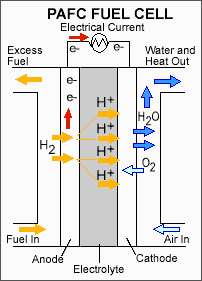
Diagram: How a Phosphoric Acid Fuel Cell (PAFC) works. A PAFC consists of liquid phosphoric acid electrolyte sandwiched between an anode (negatively charged electrode) and a cathode (positively charged electrode). The processes that take place in the fuel cell are as follows: 1. Hydrogen fuel is channeled through field flow plates to the anode on one side of the fuel cell, while oxygen from the air is channeled to the cathode on the other side of the cell.  2. At the anode, a platinum catalyst causes the hydrogen to split into positive hydrogen ions (protons) and negatively charged electrons.  3. The phosphoric acid electrolyte allows only the positively charged ions to pass through it to the cathode.  The negatively charged electrons must travel along an external circuit to the cathode, creating an electrical current.  4. At the cathode, the electrons and positively charged hydrogen ions combine with oxygen to form water, which flows out of the cell.Phosphoric Acid Fuel Cells use liquid phosphoric acid as an electrolyte—the acid is contained in a Teflon-bonded silicon carbide matrix—and porous carbon electrodes containing a platinum catalyst. The chemical reactions that take place in the cell are shown in the diagram to the right.

The Phosphoric Acid Fuel Cell (PAFC) is considered the "first generation" of modern fuel cells. It is one of the most mature cell types and the first to be used commercially, with over 200 units currently in use. This type of fuel cell is typically used for stationary power generation, but some phosphoric acid fuel cells have been used to power large vehicles such as city buses.


Diagram: How a Phosphoric Acid Fuel Cell (PAFC) works. A PAFC consists of liquid phosphoric acid electrolyte sandwiched between an anode (negatively charged electrode) and a cathode (positively charged electrode). The processes that take place in the fuel cell are as follows: 1. Hydrogen fuel is channeled through field flow plates to the anode on one side of the fuel cell, while oxygen from the air is channeled to the cathode on the other side of the cell.  2. At the anode, a platinum catalyst causes the hydrogen to split into positive hydrogen ions (protons) and negatively charged electrons.  3. The phosphoric acid electrolyte allows only the positively charged ions to pass through it to the cathode.  The negatively charged electrons must travel along an external circuit to the cathode, creating an electrical current.  4. At the cathode, the electrons and positively charged hydrogen ions combine with oxygen to form water, which flows out of the cell.Phosphoric Acid Fuel Cells are more tolerant of impurities in fossil fuels that have been reformed into hydrogen than Proton Exchange Membrane Fuel Cells, which are easily "poisoned" by carbon monoxide—carbon monoxide binds to the platinum catalyst at the anode, decreasing the fuel cell's efficiency. They are 85 percent efficient when used for the co-generation of electricity and heat, but less efficient at generating electricity alone (37 to 42 percent). This is only slightly more efficient than combustion-based power plants, which typically operate at 33 to 35 percent efficiency. Phosphoric acid fuel cells are also less powerful than other fuel cells, given the same weight and volume. As a result, these fuel cells are typically large and heavy. Phosphoric acid fuel cells are also expensive. Like Proton Exchange Membrane Fuel Cells, Phosphoric acid fuel cells require an expensive platinum catalyst, which raises the cost of the fuel cell. A typical phosphoric acid fuel cell costs between $4,000 and $4,500 per kilowatt to operate.

Alkaline Fuel Cells

Diagram: How an Alkaline Fuel Cell (AFC) works. An AFC consists of an alkaline electrolyte, typically potassium hydroxide (KOH), sandwiched between an anode (negatively charged electrode) and a cathode (positively charged electrode). The processes that take place in the fuel cell are as follows: 1. Hydrogen fuel is channeled through field flow plates to the anode on one side of the fuel cell, while oxygen from the air is channeled to the cathode on the other side of the cell.  2. At the anode, a platinum catalyst causes the hydrogen to split into positive hydrogen ions (protons) and negatively charged electrons. 3. The positively charged hydrogen ions react with hydroxyl (OH-) ions in the electrolyte to form water. 4. The negatively charged electrons cannot flow through the electrolyte to reach the positively charged cathode, so they must flow through an external circuit, forming an electrical current. 5. At the cathode, the electrons combine with oxygen and water to form the hydroxyl ions that move across the electrolyte toward the anode to continue the process.Alkaline Fuel Cells (AFCs) were one of the first fuel cell technologies developed, and they were the first type widely used in the U.S. space program to produce electrical energy and water onboard spacecraft. These fuel cells use a solution of potassium hydroxide in water as the electrolyte and can use a variety of non-precious metals as a catalyst at the anode and cathode. High-temperature Alkaline Fuel Cells operate at temperatures between 100°C and 250°C (212°F and 482°F). However, newer AFC designs operate at lower temperatures of roughly 23°C to 70°C (74°F to 158°F)

Alkaline Fuel Cells' high performance is due to the rate at which chemical reactions take place in the cell. They have also demonstrated efficiencies near 60 percent in space applications.

The disadvantage of this fuel cell type is that it is easily poisoned by carbon dioxide. 
In fact, even the small amount of CO2 in the air can affect this cell's operation, making it necessary to purify both the hydrogen and oxygen used in the cell. This purification process is costly. Susceptibility to poisoning also affects the cell's lifetime (the amount of time before it must be replaced), further adding to cost.

Cost is less of a factor for remote locations such as space or under the sea. However, to effectively compete in most mainstream commercial markets, these fuel cells will have to become more cost-effective. Alkaline Fuel Cells have been shown to maintain sufficiently stable operation for more than 8,000 operating hours. To be economically viable in large-scale utility applications, these fuel cells need to reach operating times exceeding 40,000 hours, something that has not yet been achieved due to material durability issues. This is possibly the most significant obstacle in commercializing this fuel cell technology.

Direct Methanol Fuel Cells

Most fuel cells are powered by hydrogen, which can be fed to the fuel cell system directly or can be generated within the fuel cell system by reforming hydrogen-rich fuels such as methanol, ethanol, and hydrocarbon fuels. Direct Methanol Fuel Cells (DMFCs), however, are powered by pure methanol, which is mixed with steam and fed directly to the fuel cell anode.

Direct Methanol Fuel Cells do not have many of the fuel storage problems typical of some fuel cells since methanol has a higher energy density than hydrogen—though less than gasoline or diesel fuel. Methanol is also easier to transport and supply to the public using our current infrastructure since it is a liquid, like gasoline.

Direct Methanol Fuel Cell technology is relatively new compared to that of fuel cells powered by pure hydrogen, and Direct Methanol Fuel Cell research and development are roughly 3-4 years behind that for other fuel cell types.

Proton Exchange Membrane (PEM) Fuel Cells

Proton Exchange Membrane Fuel Cells - sometime called a Diagram: How a Polymer Electrolyte Membrane (PEM) fuel cell works. A PEM fuel cell consists of a polymer electrolyte membrane sandwiched between an anode (negatively charged electrode) and a cathode (positively charged electrode). The processes that take place in the fuel cell are as follows: 1. Hydrogen fuel is channeled through field flow plates to the anode on one side of the fuel cell, while oxygen from the air is channeled to the cathode on the other side of the cell.  2. At the anode, a platinum catalyst causes the hydrogen to split into positive hydrogen ions (protons) and negatively charged electrons.  3. The Polymer Electrolyte Membrane (PEM) allows only the positively charged ions to pass through it to the cathode.  The negatively charged electrons must travel along an external circuit to the cathode, creating an electrical current.  4. At the cathode, the electrons and positively charged hydrogen ions combine with oxygen to form water, which flows out of the cell.Polymer Electrolyte Membrane Fuel Cell —  deliver high power density and offer the advantages of low weight and volume, compared to other fuel cells. Proton Exchange Membrane Fuel Cells use a solid polymer as an electrolyte and porous carbon electrodes containing a platinum catalyst. They need only hydrogen, oxygen from the air, and water to operate and do not require corrosive fluids like some fuel cells. They are typically fueled with pure hydrogen supplied from storage tanks or onboard reformers.

Proton Exchange Membrane Fuel Cells operate at relatively low temperatures, around 80°C (176°F). Low temperature operation allows them to start quickly (less warm-up time) and results in less wear on system components, resulting in better durability. However, it requires that a noble-metal catalyst (typically platinum) be used to separate the hydrogen's electrons and protons, adding to system cost. The platinum catalyst is also extremely sensitive to CO poisoning, making it necessary to employ an additional reactor to reduce CO in the fuel gas if the hydrogen is derived from an alcohol or hydrocarbon fuel. This also adds cost. Developers are currently exploring platinum/ruthenium catalysts that are more resistant to CO.

Proton Exchange Membrane Fuel Cells are used primarily for transportation applications and some stationary applications. Due to their fast startup time, low sensitivity to orientation, and favorable power-to-weight ratio, Proton Exchange Membrane Fuel Cells are particularly suitable for use in passenger vehicles, such as cars and buses.

A significant barrier to using these fuel cells in vehicles is hydrogen storage. Most fuel cell vehicles (FCVs) powered by pure hydrogen must store the hydrogen onboard as a compressed gas in pressurized tanks. Due to the low energy density of hydrogen, it is difficult to store enough hydrogen onboard to allow vehicles to travel the same distance as gasoline-powered vehicles before refueling, typically 300-400 miles. Higher-density liquid fuels such as methanol, ethanol, natural gas, liquefied petroleum gas, and gasoline can be used for fuel, but the vehicles must have an onboard fuel processor to reform the methanol to hydrogen. This increases costs and maintenance requirements. The reformer also releases carbon dioxide (a greenhouse gas), though less than that emitted from current gasoline-powered engines.

Protonic Ceramic Fuel Cells

Protonic Ceramic Fuel Cells (PCFC) are a relatively new type of fuel cell is based on a ceramic electrolyte material that exhibits high protonic conductivity at elevated temperatures. 

Protonic Ceramic Fuel Cells share the thermal and kinetic advantages of high temperature operation at 700 degrees Celsius with molten carbonate and solid oxide fuel cells, while exhibiting all of the intrinsic benefits of proton conduction in Proton Exchange Membrane Fuel Cells and Phosphoric Acid Fuel Cells

The high operating temperature is necessary to achieve very high electrical fuel efficiency with hydrocarbon fuels. Protonic Ceramic Fuel Cells can operate at high temperatures and electrochemically oxidize fossil fuels directly to the anode. This eliminates the intermediate step of producing hydrogen through the costly reforming process. Gaseous molecules of the hydrocarbon fuel are absorbed on the surface of the anode in the presence of water vapor, and hydrogen atoms are efficiently stripped off to be absorbed into the electrolyte, with carbon dioxide as the primary reaction product. Additionally, Protonic Ceramic Fuel Cells have a solid electrolyte so the membrane cannot dry out as with Proton Exchange Membrane Fuel Cells, or liquid can't leak out as with Phosphoric Acid Fuel Cells.


Solid Oxide Fuel Cells

Diagram: How a Solid Oxide Fuel Cell (SOFC) works. An AFC consists of a non-porous metal oxide electrolyte (typically zirconium oxide) sandwiched between an anode (negatively charged electrode) and a cathode (positively charged electrode). The processes that take place in the fuel cell are as follows: 1. Hydrogen fuel is channeled through field flow plates to the anode on one side of the fuel cell, while oxygen from the air is channeled to the cathode on the other side of the cell.  2. At the cathode, a catalyst causes electrons from the electrical circuit to combine with oxygen to create negatively charged oxygen ions. 3. The negatively charged oxygen ions flow through the electrolyte to the anode. 4. At the anode, the catalyst causes the hydrogen to react with the oxygen ions forming water and free electrons. 5. The negatively charged electrons cannot flow through the electrolyte to reach the positively charged cathode, so they must flow through an external circuit, forming an electrical current. 6. At the cathode, the electrons combine with oxygen to create negatively charged oxygen ions, and the process repeats.Solid Oxide Fuel Cells (SOFCs) use a hard, non-porous ceramic compound as the electrolyte. Since the electrolyte is a solid, the cells do not have to be constructed in the plate-like configuration typical of other fuel cell types. Solid Oxide Fuel Cells are expected to be around 50-60 percent efficient at converting fuel to electricity. In applications designed to capture and utilize the system's waste heat (co-generation), overall fuel use efficiencies could top 80-85 percent.

Solid Oxide Fuel Cells operate at very high temperatures—around 1,000°C (1,830°F). High temperature operation removes the need for precious-metal catalyst, thereby reducing cost. It also allows Solid Oxide Fuel Cells to reform fuels internally, which enables the use of a variety of fuels and reduces the cost associated with adding a reformer to the system.

Solid Oxide Fuel Cells are also the most sulfur-resistant fuel cell type; they can tolerate several orders of magnitude more sulfur than other cell types. In addition, they are not poisoned by carbon monoxide (CO), which can even be used as fuel. This allows Solid Oxide Fuel Cells to use gases made from coal.

High-temperature operation has disadvantages. It results in a slow startup and requires significant thermal shielding to retain heat and protect personnel, which may be acceptable for utility applications but not for transportation and small portable applications. The high operating temperatures also place stringent durability requirements on materials. The development of low-cost materials with high durability at cell operating temperatures is the key technical challenge facing this technology.

Scientists are currently exploring the potential for developing lower-temperature Solid Oxide Fuel Cells operating at or below 800°C that have fewer durability problems and cost less. Lower-temperature Solid Oxide Fuel Cells produce less electrical power, however, and stack materials that will function in this lower temperature range have not been identified.

What are Regenerative Fuel Cells?


Regenerative Fuel Cells produce electricity from hydrogen and oxygen and generate heat and water as byproducts, just like other fuel cells. However, Regenerative Fuel Cells can also use electricity from solar power or some other source to divide the excess water into oxygen and hydrogen fuel—this process is called "electrolysis." This is a comparatively young fuel cell technology being developed by NASA and others.


Trigeneration Technologies is a privately held company formed by the founder of the Renewable Energy Institute. Our products include:

Cogeneration Energy Systems
Demand Side Management
Micro-Grid
systems 
Net Zero Energy Buildings
Trigeneration   

Our cogeneration and trigeneration energy systems exceed 85% net system efficiency. This translates into significant energy savings for our clients as well as reductions in greenhouse gas emissions.

The standard cogeneration and trigeneration energy system packages we offer include the following packaged units, that come standard on a single skid, approximately 8' wide, x 20' length, in a cabinet that is sound attenuated and will meet or exceed SCAQMD and Houston/Galveston emissions regulations:


                        100 kW          150 kW          250 kW          500 kW

                         1.0 MW          2.0 MW         3.0 MW          3.5 MW


Our standard cogeneration and trigeneration energy systems can be mixed and matched so as to provide practically any size energy system needed. A recent 900 kW (see pictures below) cogeneration system's system efficiency exceeded 90% net system efficiency. 

We offer the following products, services and consulting services: 

About Us

We provide our clients with comprehensive clean power generation solutions, including "carbon free energy" and "pollution free power" systems. This includes our in-house engineering services - and assists our clients understand their best path forward through our engineering and feedstock feasibility and economic analysis. Once our clients and our company understand the specific needs, requirements and goals of our clients, we can then optimize the solution for the client that might include one or more of our "waste to fuel" products and services, including; anaerobic digester, biomass gasification plant, cogeneration plant, natural wastewater treatment plant, trigeneration plant or other waste to energy or waste to fuel solution

begin most and assist our commercial and industrial clients by providing recommendations and strategies for helping them reduce their carbon emissions, carbon dioxide emissions, greenhouse gas emissions and keep informed of current laws and pending legislation relating to climate change, global warming and how they can prepare for Cap and Trade.  See our website at:  www.CapAndTrade.net  for more information on Cap and Trade issues, pending legislation and preparing for federal laws and compliance.

Our clients benefit from our extensive experience and knowledge of issues relating to renewable energy, environmental and sustainability issues as well as implementing real world solutions that accomplish our client's goals and objectives.

We have been providing products, consulting services, information, education and solutions for reducing: 

Carbon Emissions (www.CarbonEmissions.com)

Carbon Dioxide Emissions (www.CarbonDioxideEmissions.com)

and Greenhouse Gas Emissions (www.GreenhouseGasEmissions.com) since 2003.  

No company is better prepared to help their clients in meeting these legal and environmental challenges with proven solutions that help save money through significantly lower energy expenses while simultaneously reducing or eliminating their Greenhouse Gas Emissions, or eliminating them entirely, than us!  We are the pioneers of "Carbon Free Energy," "Pollution Free Power" and "Clean Power Generation" strategies and solutions that can completely eliminate your company's Greenhouse Gas Emissions.  Our solutions and strategies provide our customers with an integrated approach to today's climate challenges with real world solutions that solve these problems, while reducing energy expenses.

Our solutions include: 

Biomass Gasification Engineering and Feedstock Feasibility Studies
Turnkey Biomass Gasification plants
Greenhouse Gas Emissions Inventory 
Greenhouse Gas Emissions Assessment
Greenhouse Gas Emissions 
Carbon Footprint verification
Sustainability Assessment 
Automated Demand Response
Biomass Gasification
Carbon Free Energy
Cogeneration plants
Demand Side Management
Net Zero Energy Buildings
Pollution Free Power
Clean Power Generation
Renewable Energy Technologies
Solar Cogeneration
Solar Desalination
Solar Detoxification
Solar Trigeneration
Trigeneration plants
Waste to Fuel


Why Choose Us?

We have proven solutions, products and services that can reduce or completely eliminate your company's Greenhouse Gas Emissions. Our staff and team has the technical expertise, depth of knowledge and affiliations with major universities that are on the cutting edge of research that is developing the solutions the world needs to solve these problems. And, we are taking these university solutions to market with products and services that solve the challenges and problems relating to climate change, fossil fuels and greenhouse gas emissions. In fact, we don't see these as problems any longer, but opportunities to help our clients get the jump on their competition, and our solutions are providing our customers with a sustainable, and durable competitive advantage.  

Frequently Asked Questions

How does our company receive credit for our early actions at reducing our Greenhouse Gas Emissions? 

Before taking action independently, companies should first contact us so that we can help them establish a Greenhouse Gas Emissions "inventory" which we can provide as a qualified third-party. 

What is the generally accepted format for sustainability reports?

At present, most companies are using the Global Reporting Initiative (GRI) protocols as this provides for the "triple bottom line" reporting which includes social, economic and environmental performance measurements. We also line to include in our triple bottom line "people, planet and profit."

What are the benefits of verifying your company's Greenhouse Gas Emissions? 

1.  Satisfies regulatory compliance regulations as well as accounting regulations relating to accuracy in reporting to customers, stockholders and other company stakeholders.

2.  Prepare for present and future regulatory compliance - Cap and Trade is coming!

3.  Establishes a present-day baseline for receiving future Greenhouse Gas Emissions Credits when your company begins taking action to reduce Greenhouse Gas Emissions. 

4.  Provides a blueprint and strategy for knowing how, where and when to begin reducing your company's Greenhouse Gas Emissions.

___________________________________________________________________________


Section 45 Tax Credits
Renewable Energy Tax Credits

Our renewable energy project development expertise has made us a leading authority of helping our clients with Section 45 Tax Credits.  Our company and our attorneys are skilled in the areas of renewable energy project finance and tax issues relating to renewable energy projects. We are able to assist our clients in connection with Section 45 tax credit project finance.

Our experience in Section 45 tax credits has helped us structure optimal renewable energy project solutions that match our clients unique economic and tax goals and requirements, which include regulatory constraints and regulatory compliance for most any state. 

Section 45 tax credits generate $.021 cents per kwh of electricity produced by the taxpayer and sold to an unrelated person or company. Section 45 tax credits are available for renewable electricity produced from certain renewable energy projects including, closed-loop biomass, open-loop biomass, geothermal power plants, solar energy, small irrigation power, municipal solid waste, and qualified hydro power production, refined coal and wind power generation.

See one of our following sites at: 

www.Section45TaxCredits.com   or  www.RenewableEnergyTaxCredits.com  

for more information or call:  (832) 758 - 0027 for more information

_____________________________________________________


What is "Cogeneration"?

Did you know that 10% of our nation's electricity now comes from "cogeneration" plants? 

And because cogeneration is so efficient, it saves its customers up to 40% on their energy expenses, and provides even greater savings to our environment through significant reductions in fuel usage and much lower greenhouse gas emissions

Cogeneration - also known as “combined heat and power” (CHP), cogen, district energy, total energy, and combined cycle, is the simultaneous production of heat (usually in the form of hot water and/or steam) and power, utilizing one primary fuel such as natural gas, or a renewable fuel, such as Biomethane, B100 Biodiesel, or Synthesis Gas

Cogeneration technology is not the latest industry buzz-word being touted as the solution to our nation's energy woes. Cogeneration is a proven technology that has been around for over 120 years! 

Our nation's first commercial power plant was a cogeneration plant that was designed and built by Thomas Edison in 1882 in New York. Our nation's first commercial power plant was called the "Pearl Street Station."


What is "Trigeneration"?

Trigeneration takes cogeneration one additional step. Trigeneration is defined as the simultaneous production of three forms of energy - typically, Cooling, Heating and Power - from only one fuel input. Put another way, our trigeneration energy systems produce three different types of energy for the price of one.  

Our Trigeneration energy systems overall system efficiencies have exceeded 85% efficiency.  

Typical "central" power plants that electric utility companies own and operate normally do not use the heat generated from the combustion and power generation process. Therefore, they are only about 30% to 35% efficient, wasting 65% to 70% of the available energy, that is simply wasted, and lost, with the heat going up their smokestacks.  

Here is a trigeneration diagram that better reflects the trigeneration process:


Trigeneration Diagram & Description
Trigeneration Power Plants' Have the Highest System Efficiencies and are 
About 300 % More Efficient than Typical Central Power Plants

Trigeneration plants are installed at locations that can benefit from all three forms of energy.  These types of installations that install trigeneration power plants are called "onsite power generation" also referred to as "decentralized energy."   

One of our company's principal's first experience with the design and development of a trigeneration power plant was the trigeneration power plant installation at Rice University in 1987 where our trigeneration development team started out by conducting a "cogeneration" feasibility study.  We installed a 4.0 MW Ruston gas turbine for the power plant.  Rice University selected an EPC company that installed the trigeneration power plant, along with waste heat recovery boilers and absorption chillers. A "waste heat recovery boiler" captures the heat from the exhaust of the gas turbine.  From there, the recovered energy was converted to chilled water - originally from (3) Hitachi Absorption Chillers - 2 were rated at 1,000 tons each, and the third Hitachi Absorption Chiller was rated at 1,500 tons. The Hitachi absorption chillers were replaced shortly after their installation by the EPC company.  The first trigeneration plant at Rice University was so successful, they added a second 5.0 MW trigeneration plant so today, Rice University is now generating about 9.0 MW of electricity, and also producing the cooling and heating the university needs from the trigeneration plant and circulating the trigeneration energy around its campus.


Trigeneration Chart
Trigeneration's "Super-Efficiency" compared 
with other competing technologies
As you can see, there is No Competition for Trigeneration!


How we make and distribute electricity is changing! The electric power transmission and distribution system (the electric "grid") is changing and evolving from the electric grid of the 19th and 20th centuries, which was inefficient, polluting, high-cost, and “dumb” which resembles:


…..To the electric grid of the 21st century (see slide below) that will be Decentralized, Smart, Efficient and provide “pollution free power” to customers who remain on the electric grid.  The electric grid of the future will be comprised of Onsite Power Generation plants fueled with Biomethane, B100 Biodiesel, Geothermal, Synthesis Gas, Wind & Solar power - located at Residential, Commercial, Industrial and City/Municipal Locations. Some customers will choose to dis-connect from the grid entirely. 

Typical "central" power plants and the electric utility companies that own them will either be shut-down, closed or go out of business due to one or more of the following:  failed business model, inordinate expenses related to central power plants that are inefficient, excessive pollution/emissions, high costs, and failure to provide efficient, carbon free energy and pollution free power that reduces our dependence on foreign oil and makes us Energy Independent while reducing and eliminating Greenhouse Gas Emissions


Our trigeneration power plants are the ideal onsite power and energy solution for customers that include:  Data Centers, Hospitals, Universities, Airports, Central Plants, Colleges & Universities, Dairies, Server Farms, District Heating & Cooling Plants, Food Processing Plants, Golf/Country Clubs, Government Buildings, Grocery Stores, Hotels, Manufacturing Plants, Nursing Homes, Office Buildings / Campuses, Radio Stations, Refrigerated Warehouses, Resorts, Restaurants, Schools, Server Farms, Shopping Centers, Supermarkets, Television Stations, Theatres and Military Bases.

We partner and collaborate with other forward thinking companies and communities that are interested in changing the outdated power and energy model of the past - inefficient and highly-polluting central power plants that average 33% efficiency - to a new paradigm and model for the future -  community-based cogeneration and trigeneration power plants at more than 90% efficiency - and therefore provides power and energy at lower prices while significantly reducing and even eliminating typical power plant emissions and greenhouse gas emissions.  

Call (832) 758 - 0027 for more information about community-based cogeneration and trigeneration power plants, or about making your community, hospital, university or other commercial facility a model for the future.

We presently contract the packaging of our new trigeneration power plants by a 3rd party/supplier but plan to build a new trigeneration manufacturing plant - near Houston, Texas where we will be able to significantly increase our trigeneration power plant production.

At about 86% to 93% net system efficiency, our trigeneration power plants are about 300% more efficient at providing energy than your current electric utility. That's because the typical electric utility's power plants are only about 33% efficient - they waste 2/3 of the fuel in generating electricity in the enormous amount of waste heat energy that they exhaust through their smokestacks.

Trigeneration is defined as the simultaneous production of three energies: cooling, heating and power.  Our trigeneration power plants use the same amount of fuel in producing three energies that would normally only produce just one type of energy. This means our customers that have our trigeneration power plants have significantly lower energy expenses, and a lower carbon footprint.

All of our trigeneration power plants produce 42 degree F. chilled water with with a 20 degree F. chilled waster option - while also generating hot water and/or steam and at least 200 kW of power. We can build trigeneration power plants up to 10 MW and with system efficiencies exceeding 85%.

Not sure what size trigeneration power plant to order or whether trigeneration is right for your business?

We can help!

Not sure what size trigeneration power plant to order or whether trigeneration is right for your business?

We can help as we offer three types of Trigeneration Feasibility Reviews & Studies!

Our Trigeneration Feasibility will help you make a decision whether one of our trigeneration power plants are right for your facility.


Trigeneration Feasibility Study and Analysis

Provides a solid basis for moving a potential renewable energy project forward.  The cost for this depends on the type, location, amount of time we require, and any additional requirements that may be included by the client. 

Generally, a trigeneration feasibility study a good option for clients considering trigeneration that need a trigeneration energy system that is over 1.0 MW and up to about 3.0 MW.

The time required to complete the study is about 90 to 120 days, on average. 

The final study we deliver is usually the basis for the customer to obtain a loan, power purchase agreement, energy services agreement or placing an order with us.

To start a Trigeneration Preliminary Study and Analysis, we require a 50% cash payment of the study cost plus a refundable deposit for our reimbursable expenses.


Trigeneration Detailed Concept, Engineering and Design Analysis

The detailed engineering design is a good option for clients that would need a trigeneration energy system with an estimated trigeneration energy system over 3.0 MW and above. In a detailed engineering design, the trigeneration energy system is conceived, designed and engineered as a custom fit and optimized energy solution for your specific facility. 

Final result is usually ready for a company to start construction. A detailed engineering design can take from 4 months to 6 months to complete. 

To start a detailed trigeneration engineering design, we require a 50% cash payment of the total fee plus a refundable deposit for our reimbursable expenses.

Our trigeneration feasibility studies and engineering design are led by our licensed engineers.  Our goal is to help you determine whether your renewable energy is viable, identify the merits of your proposed renewable energy project, identify weak points, provide our recommended course of action, as well as our recommendations for products and equipment that need further review or consideration.  Our Feasibility Studies are an excellent "foundation" for building your next renewable energy project.

If you order your new trigeneration power plant from us within 30 days of the date of delivery of our Trigeneration Feasibility Review or Study, we will reduce the cost of your new trigeneration power plant by half the cost of the study and apply the fee to the purchase.

Trigeneration is a technology whose time as come! Particularly for commercial clients who want to decrease their energy expenses and carbon footprint, while increasing energy efficiency and profits. This is possible as our trigeneration power plants surpass 85% net system efficiency. 

This is possible through our trigeneration power plants that surpass 85% system efficiency for our clients that need cooling, heating and power - which covers about 99% of all commercial buildings and companies.

While most new trigeneration power plants are capable of being fueled with clean natural gas, we are dedicated to ending the use of fossil fuels by providing renewable energy and renewable fuels such as B100 Biodiesel or Biomethane.  Simultaneously, we are focused on reducing and eliminating greenhouse gas emissions and carbon dioxide emissions.

In association with the Renewable Energy Institute, affiliate companies and investors, we provide "turnkey" trigeneration power plant development services that range from initial Engineering Feasibility & Economic Analysis Studies through project installation, start-up and commissioning, Operations & Maintenance, and Long Term Service Agreements for the lifetime of our systems.

Trigeneration Technologies' trigeneration power plants' net system's efficiencies surpass any potential competitor.  We guarantee our standard trigeneration power plants will exceed 90% net system efficiency. 

Our trigeneration plants can use renewable fuels such as Biomethane, B100 Biodiesel or Dimethyl Ether, instead of fossil fuels to run them. We also offer an optional selective catalytic reduction technology that takes NOx down to "non-detect" without the use of ammonia or urea on our new trigeneration plants.

Our range of services (some provided by affiliate companies or manufacturing suppliers) include:

Our renewable energy projects generate Renewable Energy Credit or Certified Emission Reduction credits, which provide an additional income stream from our projects.


"The
Trigeneration Experts" - the ONLY Company that Builds Integrated Trigeneration Plants on a Single Skid with Effective System Efficiencies that Exceed 90%.  Our Optional SCR System Reduces Nitrogen Oxides To "Non-Detect" Without Ammonia or Urea

Our small footprint Trigeneration Plants measurements are: 15' wide by 15' in height by and 55' in length

We Can Design, Build, and Install Your New Trigeneration Power Plant and have it online in less than 130 - 150 days!


Our "Turnkey" Integrated Trigeneration Energy Systems are Available from 100 kW to over 10 MW with system efficiencies > 90% While Providing Practically-free Heating (and Cooling with Trigeneration) and generating power for commercial and industrial customers for as low as 4 cents/kW!  We are the only company that builds, fabricates, packages (on a single skid) and "integrates" Trigeneration power plants.

The standard cogeneration and trigeneration energy system packages we offer include the following packaged units, that come standard on a single skid, approximately 8' wide, x 20' length, in a cabinet that is sound attenuated and will meet or exceed SCAQMD and Houston/Galveston emissions regulations:


                        100 kW          150 kW          250 kW          500 kW

                         1.0 MW          2.0 MW         3.0 MW          3.5 MW


Our standard cogeneration and trigeneration energy systems can be mixed and matched so as to provide practically any size energy system needed. A recent 900 kW cogeneration system's system efficiency exceeded 90% net system efficiency. 


We are committed to excellence and exceeding our customers goals and objectives, and will NOT use equipment from the following manufacturers: 

Capstone microturbines
Daewoo engines
GE Power
Guascor
Jenbacher
Kawasaki turbines 

in ANY of our cogeneration or trigeneration power plants. We can package any combination of standard size plants to come up with your optimum size system. 

Our company, and our company's manufacturers and packagers only use "industrial" engines that are made in the U.S.A.

Our standard and customized cogeneration and trigeneration energy systems use the leading brands of reciprocating engines or turbines and include our proprietary Waste Heat Recovery technologies that help us achieve system efficiencies greater than 90% and effective heat rates as low as 4050 btu's/kW.  We provide both standard and customized cogeneration and trigeneration energy systems that meet our customer's most stringent economic and environmental requirements.

Our cogeneration and trigeneration energy systems can run on renewable fuels for even greater environmental and economic savings! These fuels or energy sources include: Biomethane, B100 Biodiesel, Dimethyl-Ether, Synthesis Gas and natural gas. Net system efficiencies of our trigeneration power plants are now exceeding 90% with up to 95% lower emissions when using Biomethane, B100 Biodiesel, Dimethyl-Ether or Synthesis Gas as the fuel for Trigeneration power plants.

For pricing and delivery information on our Cogeneration or Trigeneration power plants, call (832) 758 - 0027 or send an email with your project's requirements to:  info@trigeneration.com

Read more about our Trigeneration Power Plants on our Specifications page.

Our New "Integrated" Trigeneration Plants Have 
Very High Efficiencies & Low Fuel Costs

The Effective Heat Rate is Approximately 
4050 btu/kW & System Efficiency is 92%

Pictures of a Cogeneration Energy System Built for New Industrial Customer.  This Cogeneration Plant is Rated at 900 kW and Features (2) Natural Gas Engines @ 450 kW each on one Skid.


Our onsite cogeneration and trigeneration energy systems are an ideal solution for customers wanting increased power reliability and decreased energy and environmental costs.  A few of the types of buildings and businesses that would benefit from an onsite trigeneration plant include the following:

Airports

Casinos

Central Plants

Colleges & Universities

Dairies

Data Centers & Server Farms 

District Heating & Cooling plants

Food Processing Plants

Golf/Country Clubs

Government Buildings and Facilities 

Grocery Stores

Hospitals 

Hotels

Manufacturing Plants

Military Bases

Nursing Homes 

Office Buildings / Campuses

Radio Stations

Refrigerated Warehouses 

Resorts 

Restaurants 

Schools

Server Farms

Shopping centers 

Supermarkets 

Television Stations

Theatres

For pricing and delivery information on our Cogeneration or Trigeneration power plants, call (832) 758 - 0027 or send an email with your goals, objectives and requirements to:  info@trigeneration.com


The Renewable Energy Institute is affiliated with a Solar CPV 
technology and fast-growing, "below-the-radar" solar R&D company 
that has made significant  breakthroughs in solar power efficiency and costs.

Ideal for: Electric Utilities, Commercial/Industrial 
Customers, and Real Estate Developments/Subdivisions

This H CPV technology costs about 50% less than our competitors. 

Minimum Size Available:  1 MW
10 year warranty
$3.75 million for equipment
Area required:  3 acres 
6-9 months lead time

Sites in California, Nevada, New Mexico now available

Highest Efficiencies - Lowest Costs

Call/email for more information


What is "Net Zero Energy?"

Net Zero Energy - when applied to a home or commercial building, simply means that they generate as much power and energy as they consume, when measured on a monthly or annual basis. 

What is "Copper Indium Gallium Diselenide?"

Copper Indium Gallium diSelenide (CuInSe2) is a material that provides an extremely high absorption of light ( 99%) to be absorbed in the first micron of the material. Copper Indium Gallium diSelenide is projected to be the revolutionary material that some are saying, could put typical "central" power plants and some electric utilities, out of business, as it will be much cheaper for customers to generate their own onsite power with Thin Film Photovoltaics made from these materials.   

When additional small amounts of Gallium is added to Copper Indium diSelenide, this increases its' light-absorbing band gap, thereby making the solar panel more closely match the solar spectrum of the sun.  This, in turn, increases the voltage and the efficiency of the Thin Film Photovoltaics solar panel

Solar panels produced with Copper Indium Gallium diSelenide cells have reached efficiencies of more than 20% - which is much higher than the other Thin Film Photovoltaics

Copper Indium Gallium diSelenide solar panels create more electricity from the same amount of sunlight than other Thin Film Photovoltaics panels.  This translates into a higher conversion efficiency. 

The conversion efficiency of Copper Indium Gallium diSelenide PV technologies is very stable over time, meaning its power output remains stable over many years, while the power output of many other PV materials can rapidly decline with time. 


What are "Building Integrated Photovoltaics?"

Building Integrated Photovoltaics (BIPV) are solar energy systems that are integrated into a part of the building, that serve as the building's exterior or the building's skin. 

Commercial buildings and facilities (including houses) that integrate their own solar power systems into the building's exteriors, are referred to as "power buildings."

The technology that makes this possible is "Thin Film Photovoltaics."


What are Thin Film Photovoltaics?

Without a doubt, the most exciting technology in the solar power industry is "Thin Film Photovoltaics."  Thin Film Photovoltaics technology represents the next big thing in renewable energy and solar power as it integrates nanotechnologies into the production of solar photovoltaics. 

According to the Department of Energy, the recent technological advances in thin film photovoltaics make this a very exciting time to be in the solar energy industry.  These advances have led to many new developments in the components and manufacturing of thin film photovoltaics. This has made thin film photovoltaics cheaper to manufacture as they are also now easier to install since they are extremely versatile, flexible, bendable, and much lighter.

Thin film photovoltaics  have led many to believe that as much as 50% of our nation's future power will be generated by "power buildings" that integrate "building integrated photovoltaics" or "BIPV" into the building's skin or exterior surfaces, that convert sunlight into "pollution free power" for use in the building.  This also designates these buildings (and homes) as "Net Zero Energy Buildings" and make the option for going grid-free, or not connecting to the grid, a real possibility.

According to the Department of Energy, the market potential for printed electronics will grow into a $47 billion market by 2018.  Thin film photovoltaics represents a significant portion of this market - and based on this heavily researched solar technology, thin film photovoltaics now represents a $20 billion/year industry in the U.S.

The solar PV panels produced under the thin film photovoltaics umbrella have the potential to produce power significantly cheaper power than today’s typical silicon-based PV panels.  The panels are usually made in the form of a monolithic piece of glass, upon which various thin films are deposited, although a number of firms are working on depositing the materials on a substrate, such as stainless steel or plastic.

Types of Thin Film Photovoltaics there are primarily three types of thin film photovoltaics and include:

  1. Amorphous Silicon

  2. Cadmium Telluride

  3. Copper Indium Gallium Diselenide

Amorphous Silicon had the largest share of the thin film photovoltaics market through 2006. It has been researched for the longest period of time, may be the best understood material of the three and has been commercial for the longest. Cadmium Telluride has the remaining share and is growing. 

Thin Film Photovoltaics Advantages over Crystalline Silicon Photovoltaics


What is a Net Zero Energy Building?

A Net Zero Energy Building produces as much energy as it uses over the course of a year. Net Zero Energy Buildings are very energy efficient. The remaining low energy needs are typically met with on-site renewable energy. 

There is no such thing as a "zero energy building."

EVERY building uses energy.  

The important considerations are, 

1.  How efficient is the building?  

2.  How much energy does the building use?  

3.  How much "carbon free energy" or "pollution free power" is generated by the buildings' own onsite renewable energy system?

4.  What are the utility company's prices for the excess power generated and sent to the grid? 
(see: Net Energy Metering)

5.  How difficult is it to interconnect the renewable energy system of the building with the utility company's powerlines/electric grid?   

At the heart of Net Zero Energy Buildings is the idea that buildings can meet energy requirements from low-cost, locally available, nonpolluting, renewable sources. 


What is Net Energy Metering?

Net energy metering is used to measure a customer's total electric consumption against that customer's total on-site electric generation.  When a customer's onsite generation of power exceeds the amount that they use, the customer's solar energy system (or other renewable energy system) exports the extra electricity to the grid.  When the power requirements of the customer exceeds their onsite generation of power, the customer imports the electricity they need from electric grid. The customer pays the electric company for any extra power they use over the amount they generate - OR -  the customer receives a credit or refund from the electric company if they exported more power to the grid, than what they consumed.  

Renewable Energy Is Necessary for Net Zero Energy Buildings

Much focus is placed on energy efficiency as the most cost-effective way to reduce energy use in commercial buildings. However, consumption can be reduced only so much. There is a point at which the cost of adding efficiency measures is higher than that of using renewable energy such as thin film photovoltaics and other solar energy systems

Aggressive energy efficiency strategies can reduce a building's energy consumption by 50% to 70%. Renewable energy technologies must be used to reach the goal of a net-zero energy building (NZEB).

Supply-Side Technologies

Various supply-side renewable energy technologies are available for Net Zero Energy Buildings. Supply-side technologies, often called energy producers, collect natural energy and transform it into a useful form. Examples of these technologies include PV, solar hot water, wind, hydroelectric, and biofuels.

Ranking of Energy Options

All renewable sources are favorable over conventional energy sources such as coal and natural gas; however, the U.S. Department of Energy recommends the following ranking for these options (the lower numbers are preferable):

Option Number

NZEB Supply-Side Options

Examples

0

Reduce site energy use through low-energy building technologies

Daylighting, high-efficiency heating, ventilation, and air-conditioning equipment (HVAC), natural ventilation, evaporative cooling

On-Site Supply Options

1

Use renewable energy sources available within the building's footprint

PV, solar hot water, and wind located on the building

2

Use renewable energy sources available at the site

PV, solar hot water, low-impact hydroelectric, and wind located on-site, but not on the building

Off-Site Supply Options

3

Use renewable energy sources available off site to generate energy on site

Biomass, wood pellets, ethanol, or biodiesel that can be imported from off site; waste streams from on-site processes that can be used on-site to generate electricity and heat

4

Purchase off-site renewable energy sources

Utility-based wind, PV, emissions credits, or other "green" purchasing options; hydroelectric is sometimes considered

This hierarchy is weighted toward renewable technologies within the building footprint and site. Rooftop PV and solar water heating are the most applicable supply-side technologies for Net Zero Energy Buildings. Other supply-side technologies such as parking lot-based wind or solar energy systems may be available.

The goal in developing the ranking was to encourage technologies that:


Solar Trigeneration
www.SolarTrigeneration.com

* FREE SOLAR POWER SYSTEMS!

Through an affiliated partner company, we are now installing *Free Solar Power Systems for qualified commercial businesses in California and Texas.

To qualify for our Free Solar Power Systems, businesses must:

We expect ALL of our customers will be very happy knowing that the clean, green, renewable power they are using is: 

To find out if your business qualifies for one of our Free Solar Power Systems, call (832) 758 - 0027 today!


"Solar Trigeneration" is Here!!
Residential, Commercial and Industrial Customers:
Reduce or COMPLETELY ELIMINATE
Your Electric Power & Natural Gas Expenses


Stop Paying High Electric and Natural Gas Rates!
 
"Cut the Cord" to the Electric Company!

Our "Solar Trigeneration™" Power and Energy Systems
Generate Carbon Free Energy and Pollution Free Power
Which is Sustainable, Clean, Renewable and Affordable

Solar Energy Systems provides cooler, cleaner, greener power and energy project development services. We specialize in renewable energy technologies and renewable fuels including; B100 Biodiesel, Biomethane, E100 Ethanol and Synthesis Gas.

Our Solar Energy Systems are an environmentally-friendly and economically-superior choice to expensive natural gas and electricity. Additionally, our renewable energy technologies generate "green tags" or a Renewable Energy Credit.  

We provide Solar Power and Energy systems that we refer to as "ecogeneration" solutions that produce cooler, cleaner, greener power and energy for our customers and our environment. Unlike most companies, we are equipment supplier/vendor neutral. This means we help our clients select the best equipment for their specific application. This approach provides our customers with superior performance, decreased operating expenses and increased return on investment. 


Our company provides turn-key project solutions that include all or part of the following: 

For more information: call us at: 832-758-0027


Net Zero Energy Buildings
www.NetZeroEnergyBuildings.com

The Audubon Nature Center Installs Solar Trigeneration  System
Making this one of the World's First
"Net Zero Energy Buildings"
at Their New Facility in Los Angeles, California

NO CONNECTION TO THE ELECTRIC UTILITY!

The Solar Trigeneration  Provides All of their Facility's (5000 sq.ft.)
Cooling, Heating and Power Requirements, Even After the Sun Sets
And WITHOUT ANY CONNECTION to the Electric Utility
with out Solar Trigeneration System!


The Sun Powers the Audubon Nature Center's Solar Trigeneration  
System at Debs Park in Los Angeles. The Audubon Nature Center's 
building is one of the world's first "Net Zero Energy Buildings." 
The Solar Trigeneration System Consists of a 10 Ton “Solar Absorption Cooling"  
System Matched with a Solar Electric Power System


By:  Monty Goodell, M.B.A.
www.SolarTrigeneration.com

Los Angeles, California

There is now a better, more efficient, “pollution free power” solution for cooling, heating and powering homes and commercial buildings where solar energy is available. It's called Solar Trigeneration

Solar Trigeneration is defined as the simultaneous generation of cooling, heating and power with only the free solar energy from the sun providing the "fuel". Solar Trigeneration is now a reality at the Audubon Center at Debs Park several miles from downtown Los Angeles and is one of the world's first "Net Zero Energy Buildings."

The Audubon Nature Center is totally powered by the sun’s energy and the building operates entirely “grid-free” and without any electric connections to the electric grid, or natural gas connections – a truly sustainable power and energy solution. Best of all, the Audubon Center doesn’t rely on the over-burdened electric grid or even natural gas.  Therefore, the Audubon Nature Center NEVER receives an electric bill or natural gas bill.... ever!

The Audubon Nature Center's 5,000 square foot office and conference facility is powered by a Solar Trigeneration system that features a 25-kilowatt solar electric power system where the energy is stored in a bank of batteries. The Center is cooled by a 10-ton solar absorption cooling system powered by an array of very efficient solar heat pipe vacuum tube thermal collectors.  The collectors heat the water to temperatures of 200+ degree F stored in a 1,200 gallon insulated tank, another type of inexpensive battery. The Solar Trigeneration system at the Audubon not only provides the air-conditioning in the summer but also heats the building in the winter, and provides the hot water for the kitchen and bathrooms. 

Absorption chillers, and cooling with solar energy with an absorption chiller are not new technologies.  In fact, absorption chiller technology is over 70 years old.  The first refrigerators were powered by propane gas to run the absorption chillers that used ammonia as a refrigerant.  Electricity and the electric compression chiller gained popularity only because of the convenient “plug and play” appliance and relatively cheap electric rates.  Electricity is no longer economically, or environmentally “cheap.”

Cogeneration refers to the simultaneous production of heat and power. Cogeneration plants are much more efficient as compared with typical power plants.  Cogeneration is usually about 55% to 70% efficient in terms of overall system efficiency, or about 200% more efficient than typical power plants.  However, cogeneration power plants are fueled by natural gas, which is a limited resource, and whose price has exploded as a result of all the new cogeneration plants that have been built and fueled by natural gas. Even in early 2001, the price of natural gas was only $2.75 - $3.25 per mmbtu. However, with all of the new cogeneration power plants, limited supply of natural gas, and the huge demand placed on natural gas for fueling the new cogeneration plants, the price of natural gas is now around $7.50 - $8.50 per mmbtu.

Solar Trigeneration is an EcoGeneration solution.  EcoGeneration refers to a power and energy system that uses the “natural” energy or fuel that is available for a specific site or location. Such energy or fuel includes, solar, wind, BioMethane, geothermal, and ocean power, including ocean tidal and ocean thermal energy conversion. For example, in the desert areas of the Southwestern U.S. , there is an abundance of solar energy. Therefore, home-owners and business owners in this part of the country should seriously consider an EcoGeneration system (“ecogen system”) that optimizes the opportunities available through solar energy

Today, the cause of the summer peak electric demand, electric supply problems, and black-outs, are the result of the energy crisis in California , primarily attributed to the air conditioning load. Over 40 percent of the electricity generated every day goes is used for air conditioning.  At this time of year, the electric utilities are forced to turn on all of their power plants to generate the “peak” demands required by the customers, primarily for air-conditioning.  This means that all of the efficient power plants, the inefficient power plants, along with all of the “peaking” power plants have to run to generate the electricity needed. The high cost of meeting the peak demand is passed on to the consumers with rates of $.20+ per kWh during the summer months.   For fixed income seniors living in desert communities, they are already forced to conserve on energy, food, water, and other necessities of life. 

Greater Demands on California’s Limited Electric Supply, Lack of New Electric Power Supplies, and This Summer’s Heat Wave are Compounding the Problem Leading to the “Perfect Electric Storm”

Many people will remember the movie “The Perfect Storm” from several years ago, when several storms came together in the northeastern part of the U.S. to produce a deadly and catastrophic “perfect” storm. Today, a different type of “perfect storm” is brewing in California . The storm that’s looming on the horizon in California is a “perfect electric storm” wherein the supply of electricity from the electric utility company’s power plants are unable to keep-up with the demand – meaning a black-out, or loss of electricity, like the black-outs from previous years, and like the northeastern black-out from 2003.

The most likely time of year for a black-out in California , unfortunately, is the summer, when air-conditioners are running at the maximum, and placing the maximum load on California ’s electricity supply.  Should such a black-out occur in the desert areas of California, where daily high temperatures routinely reach 110 degrees and higher, and where a significant percentage of the population is comprised of retired and senior citizens, and should the black-out be prolonged, a number of deaths will be the likely outcome. People, and especially the elderly, simply cannot tolerate prolonged high temperatures

How Do We Prevent the “Perfect Electric Storm” from Occurring in California and Other Regions in the U.S.?

Another major concern is how do we prevent the “Perfect Electric Storm” from happening, like the Northeast Blackout several summers ago, especially for people living in the desert?  California ’s energy authorities are warning of a possible energy crisis during the hot summer months, due to the excessive and prolonged summer temperatures where demand increases by over 40 percent.  Compounding the problem is the rising demand for electricity due to population growth and the limited transmission capacity in some areas in the region.  According to the California Energy Commission, the State must build three natural gas-fired 500-megawatt peaking power plants, every year, just to keep up with the growing demands of electricity. Failure to keep up with demand means The problem is getting worse due to the population growth in the Inland Empire , Coachella Valley and Antelope Valley. The projected power gap for the coming summers of 2006, 2007, and 2008 is very bleak.

Governor Schwarzenegger’s “Million Solar Roofs” program and the passage of the 2005 Federal Energy Act will be the foundation to create a “Perfect Solar Storm” to trigger the Solar Economy throughout California. 

With the threat of California’s seniors and elderly dying from heat exhaustion due to power outages, black-outs, rolling black-outs and the rising costs of electricity and natural gas, combined with the continuing impact of global warming, the perfect solution is to create a Solar Revolution by cooling, heating and powering the desert with solar energy and technologies like Solar Cogeneration or Solar Trigeneration.

To find our more about the new Solar Trigeneration system at the Audubon Center in Los Angeles, or arrange for a tour of the Audubon Center, or discuss your Solar CHP, Solar Cogeneration or EcoGeneration requirements, call Monty Goodell at 832-758-0027

100%

The Audubon Center's new Solar Trigeneration power and energy system
makes this building a "Net Zero Energy Building"


100%
The Audubon's Roof showing the Solar Thermal Collectors, part of the 
Solar Trigeneration power and energy system


100%

The heart of the Audubon's Solar Trigeneration power and energy system
provides "free heating, cooling and domestic hot water," a "net zero energy building."


100%

The hot water from the Solar Thermal Collectors on the roof of the Audubon is pumped here for producing the building's heating, cooling and domestic hot water.
Hot water is stored in the tank on the left for overnight.


* Some of the above information from the Department of Energy website with permission.


We support the Renewable Energy Institute by donating a portion of our profits to the Renewable Energy Institute in their efforts to reduce fossil fuel use through renewable energy and their goals to end fossil fuel pollution by reducing/eliminating Carbon Emissions, Carbon Dioxide Emissions and Greenhouse Gas Emissions.

The Renewable Energy Institute is "Changing The Way The World Makes and UsesEnergy by Providing Research & Development, Funding and Resources That Creates Sustainable Energy via 'Carbon Free Energy' and 'Pollution Free Power' Through Expanding the use of 'Renewable Energy Technologies'"


Renewable Energy Institute


www.RenewableEnergyInstitute.org

info@RenewableEnergyInstitute.org


Hydrogen Fuel Cell
www.HydrogenFuelCell.net

info@HydrogenFuelCell.net

Tel.  (832) 758 - 0027

© Copyright 2008 - 2009
All Rights Reserved